

Evening exercise gets unfairly labeled as “bad for sleep,” but real life isn’t that simple. For many people, a well-timed workout helps them unwind, feel accomplished, and sleep better. For others, the same workout turns into a 2 a.m. “wired” marathon. The difference usually comes down to intensity, timing, light/stimulation, and your personal nervous system.
Informational only. Not medical advice.
Table of Contents
TL;DR
- Evening exercise can support sleep when it’s the right intensity and you give yourself time to downshift.
- A good default is finishing workouts 1–2 hours before bed, and moving harder sessions earlier if you notice you’re “wired.”
- Calming options (walking, yoga, stretching) are usually easier to place later than high-intensity training.
- The “secret weapon” is a real cooldown + wind-down routine, not just stopping your workout and jumping into bed.
- Track your response for 2 weeks and adjust—people vary a lot.
Why Evening Exercise Can Help (or Hurt) Sleep
Evening exercise can help because it:
- lowers stress after a long day,
- builds healthy sleep pressure (your body’s drive to sleep),
- improves mood and routine consistency.
It can hurt sleep when it keeps your body in “go mode,” especially if your workout is intense or ends too close to bedtime:
- heart rate stays elevated,
- body temperature stays high,
- adrenaline/alertness lingers,
- bright lights + loud music + screens keep your brain stimulated.
The goal isn’t “no evening workouts.” The goal is learning how to flip the switch from training mode to sleep mode.
If your late workouts leave you feeling wired or mentally “on,” you might be dealing with the same sleep–stress loop we break down in Insomnia and Anxiety: Signs, Habits, and Support.
The 9 Rules for Better Sleep
These rules are built to keep evening exercise compatible with deep, restful sleep.
Rule 1) Match intensity to bedtime
If your bedtime is soon, go lighter. If you want to train hard, finish earlier when possible.
Simple idea:
- Light (walk, yoga, mobility): easier to place later
- Moderate (steady cardio, normal strength training): leave more buffer
- High intensity / high volume (HIIT, heavy lifting + lots of sets, long runs): earlier is safer
Rule 2) Use the “finish time” table
Instead of one strict cutoff, use a practical time window.
| Workout type | Better finish time before sleep |
|---|---|
| Light (stretching, yoga, easy walk) | 30–90 minutes |
| Moderate (steady cardio, moderate lifting) | 1–2+ hours |
| Hard/high strain (HIIT, long run, heavy volume lifting) | 3+ hours (if you get wired) |
This isn’t a rulebook—just a smart starting point.
Rule 3) Always cool down (non-negotiable)
A cooldown is the bridge between effort and rest. Without it, your body may stay “revved.”
Try this 6–10 minute cooldown:
- 2–3 minutes very easy movement
- light stretching (hips, calves, chest)
- 6 slow breaths (long exhale)
Rule 4) Treat the hour after as “sleep prep”
Evening exercise works best when the post-workout hour doesn’t turn into a stimulation festival.
Good choices: shower, dim lights, calm music, easy stretching, reading.
Avoid if you get wired: intense gaming, doomscrolling, bright overhead lights.
Rule 5) Don’t stack stimulants
If you’re training late, caffeine can be the hidden saboteur.
Quick win: try no caffeine after lunch for 7–10 days and note:
- time to fall asleep
- nighttime awakenings
- how you feel in the morning
Rule 6) Eat for recovery without “heavy dinner regret”
After evening exercise, some people sleep worse if they crush a huge heavy meal right before bed.
A simple approach:
- normal dinner timing when possible
- if needed, a small recovery snack (not a feast)
- avoid spicy/greasy “gut bombs” late
If late meals or certain foods make you uncomfortable at night, it can interfere with sleep quality—here’s a deeper guide on the connection in Sleep and Gut Health: Gut, Mood & Recovery.
Rule 7) Hydrate, then taper
Hydration matters, but chugging water right before bed can cause wake-ups.
Tip: drink post-workout, then gradually taper in the last hour.
Rule 8) Keep your schedule boring (in a good way)
The more consistent your routine is, the easier it is for your body to predict “workout now, sleep later.” Consistency makes evening exercise feel less disruptive over time.
Rule 9) Personalize with a 2-week experiment
People respond differently. Run a small experiment instead of guessing.
Pick one change for 2 weeks:
- finish 45 minutes earlier, or
- reduce intensity slightly, or
- lengthen cooldown, or
- remove late caffeine
Track 3 simple things:
- how long it takes to fall asleep
- awakenings
- morning energy
Best Evening Workouts by Time Window
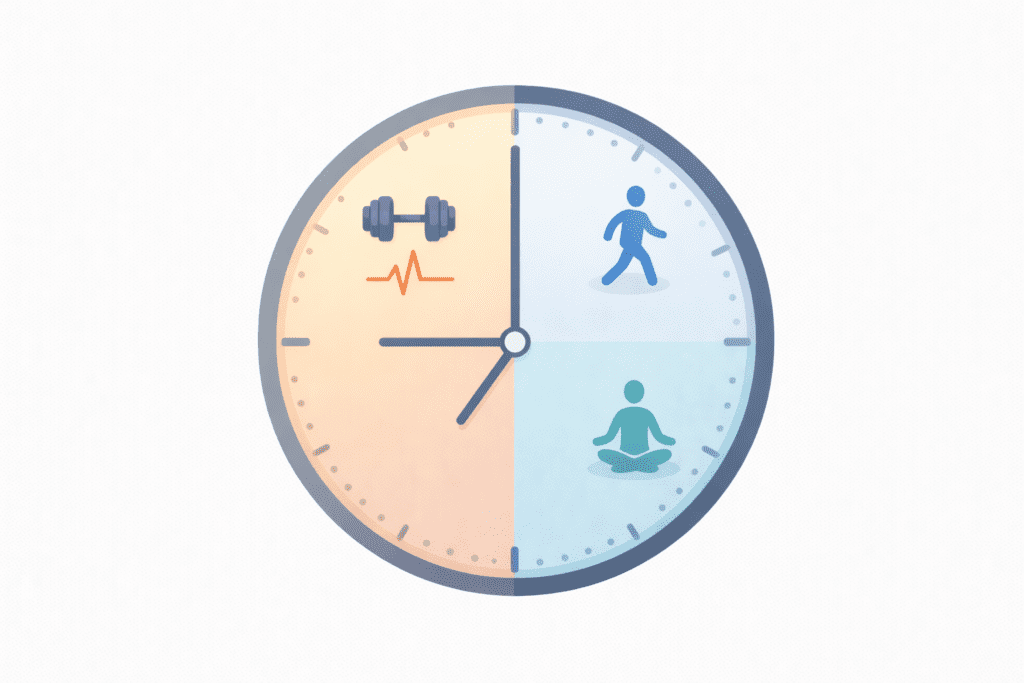
Use this when your schedule is tight and you want the “right” type of evening exercise.
If you’re 30–60 minutes from bed
Keep it calming:
- gentle yoga
- mobility + stretching
- easy walk + breathing
- foam rolling (light)
If you’re 60–120 minutes from bed
Moderate options:
- brisk walk / steady bike
- easy jog
- moderate strength training (longer rests, not a max-out session)
If you’re 2–3+ hours from bed
This is the safer window for harder sessions:
- intervals/HIIT
- heavy lifting (higher effort)
- longer cardio sessions
Troubleshooting: If Evening Exercise Makes You Wired
If evening exercise keeps you awake, don’t panic. It’s usually fixable.
Try this checklist
- Too intense? Drop the intensity one notch.
- Too late? Shift earlier by 30–60 minutes.
- No cooldown? Add 8–10 minutes of downshift.
- Too much light/screen after? Dim the environment.
- Caffeine too late? Move it earlier.
- Hot shower too late? For some people, a warm shower helps; for others, it energizes—test.
The “wired but tired” rescue plan
If you’re in bed wide awake:
- get up briefly,
- keep lights dim,
- do something boring and relaxing (reading/stretching),
- return when sleepy.
This helps your bed stay associated with sleep—not frustration.
If You’re Buying Gear or Wearables
Disclosure: Some links on lifewith.health may be affiliate links, at no extra cost to you.
What to look for
- Comfort first: especially if it’s worn at night
- Simple tracking: bedtime/wake time, awakenings, trends (not perfection)
- Quiet home equipment: mat, resistance bands, light dumbbells, walking pad (if it doesn’t ramp you up)
- Easy setup: the best gear is the gear you’ll actually use
Red flags
- “Guaranteed deep sleep” promises
- Aggressive marketing that makes you anxious
- Devices that push high-intensity workouts right before bed as “ideal for sleep”
FAQ
1) Is evening exercise always bad for sleep?
No. For many people, evening exercise is fine—especially if it’s light to moderate and you have a wind-down.
2) How long before bed should I finish a workout?
A common starting point is 1–2 hours. If you do very intense training and feel wired, try finishing earlier.
If you want the research behind the “finish earlier when it’s intense” idea, this large 2025 study is a good reference: Nature Communications: evening exercise timing and sleep.
3) What types of evening workouts are best?
Walking, stretching, yoga, and mobility work are usually the most sleep-friendly.
4) Why do late workouts sometimes keep me awake?
Your heart rate, temperature, and alertness can stay elevated—plus bright light and screens can add stimulation.
5) Should I use a sleep tracker?
It can help you spot patterns, but don’t let it become a stress trigger. If tracking makes you anxious, simplify or pause it.
Conclusion
Evening exercise doesn’t have to compete with good sleep. The winning combo is smart timing, the right intensity, and a real downshift. If you keep late workouts calmer, avoid stacking stimulants, and build a predictable post-workout wind-down, you can support both fitness and rest—without feeling like you have to choose.